

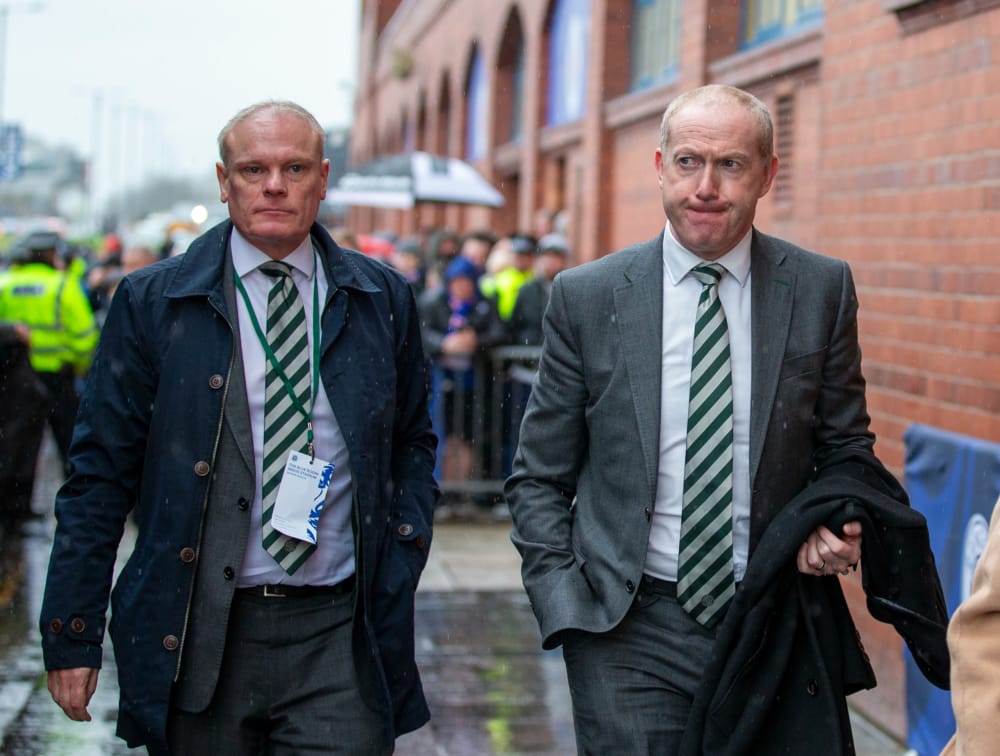
If you ever needed proof that the concept of Bizarro World isn’t confined to Superman comics or Seinfeld episodes, you need only wander into the executive corridors of Celtic PLC.
For those unfamiliar with the concept Bizarro is Superman’s imperfect duplicate — a chalk white, square jawed anti hero who believes that doing the wrong thing is right, and doing the right thing is criminal.
In Seinfeld, Elaine briefly escapes Jerry Seinfeld’s dysfunctional orbit by befriending “Bizarro Jerry,” a man who is polite, considerate, and emotionally mature — the exact opposite of the show’s core characters.
Celtic, under the long shadow of Peter Lawwell, the steady hand of Michael Nicholson, and the ever present influence of Dermot Desmond, has somehow managed to create a footballing version of this inverted universe. A place where logic is reversed, incentives are upside down, and success is defined not by trophies or European progress but by the size of the tax bill generated from record profits.
Welcome to Bizarro World population: the Celtic board
The Bizarro Logic of Profit Over Progress
Successful football clubs invest in infrastructure, talent, and long term competitiveness. They build squads capable of thriving in Europe, not merely surviving domestically. They treat profit as a means to an end, not the end itself.
But in Celtic’s Bizarro World, the board appears to believe the opposite.
Rather than reinvesting the club’s substantial revenues into the playing squad, the training environment, or the broader footballing operation, Celtic has become a profit-maximising machine.
Year after year, the club posts enormous surpluses. And year after year, those surpluses are celebrated as if they were trophies. The board pats itself on the back for “prudence,” “stability,” and “risk management”. Meanwhile the footballing side of the organisation is left to operate with one hand tied behind its back.
The irony is painful: Celtic’s strategy, presented as risk averse, is in fact the opposite. By refusing to invest meaningfully in the squad, the club repeatedly fails to reach the lucrative stages of European competition — forfeiting tens of millions in potential revenue. The board’s obsession with short term financial neatness has created long term footballing fragility.
It is the Bizarro version of risk management: avoiding investment to avoid risk, only to create a far bigger risk through underinvestment.
Structural Failure
Celtic’s repeated stumbles in Europe are not random. They are structural. They are predictable. And they are the direct consequence of a board that treats Champions League qualification as a bonus rather than a baseline.
In the real world, clubs invest before European campaigns to maximise their chances of success. In Celtic’s Bizarro World, investment is withheld until after failure, at which point the board expresses disappointment and promises to “learn lessons.”
The club’s European record over the past decade is not merely underwhelming — it is a case study in how not to run a club with Celtic’s resources, fanbase, and historical stature. The board’s refusal to strengthen the squad at key moments has cost Celtic qualification, prize money, coefficient points, and prestige. It has also cost the club the chance to grow commercially in line with its potential.
In Bizarro World, this is apparently fine. After all, the balance sheet looks terrific.

The Tax Bill Trophy
Perhaps the most surreal aspect of Celtic’s governance is the celebration of massive tax liabilities. In the real world, a large tax bill is a sign that a club has made substantial profits — but also that it has failed to reinvest those profits in ways that would reduce taxable surplus while strengthening the football operation.
It is the ultimate inversion of footballing logic: Celtic is punished financially for not investing, and the board treats the punishment as evidence of good stewardship.
This is the kind of plotline that would make Jerry Seinfeld raise an eyebrow and say, “So let me get this straight… you’re happy you paid more tax because you didn’t spend money improving your team?”
The Celtic Culture of Comfortable Stagnation
The Celtic board’s worldview is built on a peculiar form of comfort. Domestic dominance — or the assumption of it — has bred complacency. The club’s leaders appear to believe that Scottish success is guaranteed, European success is optional, and financial success is paramount.
But football does not stand still. European competition has evolved. And Celtic, despite its resources, risks becoming the Bizarro version of a superclub: powerful on paper, fragile in practice.
The board’s strategy has not merely failed to maximise Celtic’s potential — it has actively constrained it.
Escape from Bizarro World
Escaping Bizarro World requires doing the opposite of what the Celtic board has done for years:
- Invest in infrastructure
- Invest in playing talent
- Invest ahead of European campaigns
- Treat profit as a tool, not a destination
- Recognise that risk aversion can itself be risky
Celtic PLC has become a case study in inverted logic — a football club run as if financial tidiness were the ultimate goal and footballing ambition a dangerous indulgence. Under Lawwell, Nicholson, and Desmond, Celtic has drifted into a Bizarro World where doing the wrong thing is celebrated, doing the right thing is feared, and success is measured not in European nights but in tax liabilities.
The tragedy is that Celtic does not need to live in this universe. It has the resources, the fanbase, and the heritage to operate in Superman’s world — the real world — where ambition is rewarded, investment is strategic, and success is pursued rather than feared.
But until the board embraces that reality, Celtic will remain trapped in Bizarro World: a place where everything is backwards, and everyone around the board table pretends it makes sense.
Select Celtic365 as a “Preferred Source” on Google News for prompts to the independent news and opinions that you respect.
RELATED READING
CLICK HERE for five reasons supporters don’t trust Celtic Connect
CLICK HERE for Michael Nicholson fails Martin O’Neill

14 Comments
by Dan
Your very narrow minded. You have made no mention of the upgrades at Lennoxtown or the £20million spent on Barrowfield. Both major infrastructure projects
by Editor
Delighted to have upset you Dan.
When can we expect the next Champions League level player to follow Kieran Tierney out of the Academy? Only been 11 years in the waiting.
Kind regards to yourself and the other #happyclappers out there that set their friends at Ibrox as the benchmark.
by Quietly Brilliant
Well Said Sir 👏
by Chris
Get well soon Dan
by Stevie Bhoy
Spot on. For 10 Champions League failures is a cost of estimate 400 million. That could build us a new main stand complete with new roof, enlarging capacity and corporate hospitality.
There is no reason why Celtic shouldn’t have a squad full of players 8-12 million.
We took Bayern all the way a couple of years ago under strength. Imagine we tried to maximumise our potential. We also need in place a good scouting system and find a way to develop youth players to first team players
by Jerry Woods
Poor Dan
You ask for comments
Dan replies
Then you rip the arse of him because his view is different from yours
Typical Blogger
Jerry Woods
by Editor
The comments of Dan and other happy clappers like yourself will always be challenged on this site.
Stick with the groovy gang over on Quick News to celebrate 22 years of failure in Europe under your corporate heroes, and don’t forget the warnings over getting kicked out of Europe for breaching FSR.
by Eddie McKelvies Capri
Now that it has been repeated a couple of times by Senior Managers at Celtic why on Earth was that ridiculous statement about “breaching FSR” not questioned or called out? Absolutely bizarre that a senior executive wasn’t called out by saying something as stupid as that!!
Jeez, what’s next, this years Sevco manager being compared to Klopp? 🙂
by Cairney Robert
No mention of the 3 new players costing at least 23 million between them… quality over quantity…get behind us and leave the negative bullshit to the Scottish press…
by Editor
Three signings, interesting. I make it two.
Do you remember the two signings costing £10m in the last week of August 2025? Both on five year contracts?
Or the seven dud projects signed by Pete’s talentless laddie in the summer of 2023?
You are on the wrong site for happy clapping, this place just isn’t for you and the Balance Sheet Bhoys.
by Quietly Brilliant
Certainly A LOT of Good Points Made Sir!……. But Sadly Everything Seems to Be Driven By Mr Desmond???
by Jerry Woods
Mr Editor
Thanks for removing Dan and I to the Derogatry (happy clappers ) section of Celtic Park
Personally when you start using insults to justify a blog you have written that’s the act of some one with No Credentials
by Editor
Not removed mate.
It is good to get the deluded cult-like views of yourself and Dan to remind supporters that there are many Celtic fans that think finishing above their O** F*** pals is an incredible achievement.
Not Another Penny to Mick the Mute.
by Shay Byrne
Time and again we hear this, thriving in Europe in a financial landscape way beyond our means or “DD villanised and sack the board while you’re at it brigade “ when is enough enough?